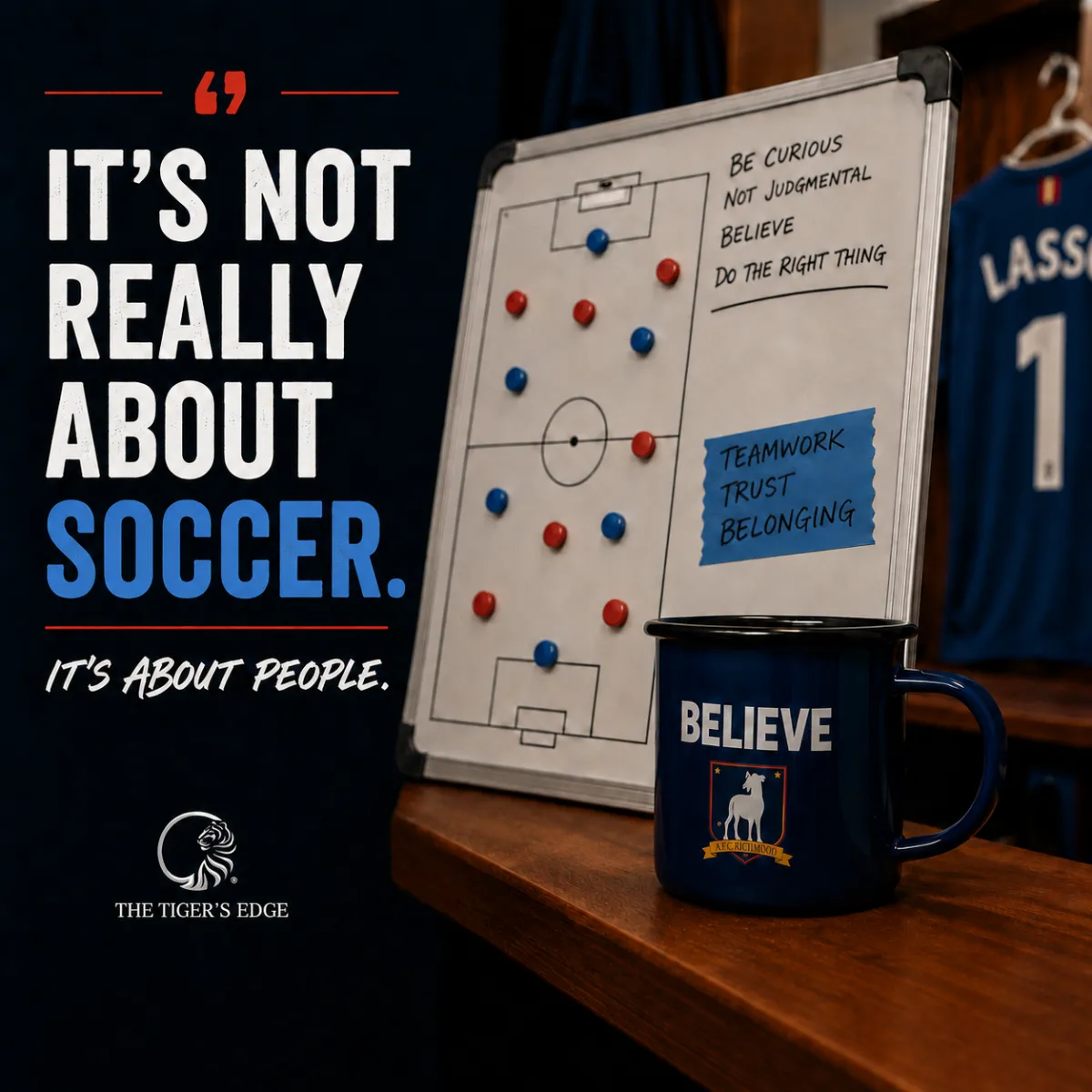
It’s Still Not Really About Soccer
I love Ted Lasso.
I love the humor. I love the heart. I love how a show that could have stayed a simple fish-out-of-water comedy keeps going somewhere deeper.
And yes, I love the soccer part too.
The games give the show its energy. Someone wins, someone loses, fans have opinions, pressure builds, and people have to deal with what success and disappointment bring out in them.
But soccer is not why the show stays with me.
The people are.
That is part of what I keep coming back to as I get closer to sharing Inspired by LIFE: Redefining the Future of Leadership. The book comes from a belief that leadership lessons are not limited to the places we usually expect to find them. Business matters. Coaching matters. Formal development can be incredibly valuable. But some of the lessons that shape us also come from family, sports, nature, animals, music, movies, books, mistakes, and the stories we keep thinking about after they are over.
I do not watch Ted Lasso trying to turn it into a leadership seminar. I watch it because I enjoy it. But every once in a while, something lands differently. A character, a conflict, a team moment, or even a small exchange feels familiar in a way that is hard to ignore. It may remind me of someone I coached, a team I led, a student I taught, or a moment from my own life that I thought I had already figured out.
That is why good stories stick. They help us recognize something before we have fully named it.
In Ted Lasso, soccer gives everyone something to focus on. In business, the scoreboard looks different. It may be growth, client outcomes, quality, innovation, retention, execution, or any number of things an organization is trying to make happen.
Whatever the metric is, people feel the pressure around it.
I spent too many years in corporate life to minimize that. Teams have to deliver. Leaders have to make decisions, communicate clearly, address what is not working, and help people move the work forward.
The part that gets interesting is that no team delivers through a strategy document alone.
People have to carry the strategy. They have to trust each other enough to execute it. They have to handle pressure, disappointment, conflict, success, ego, insecurity, and change while still doing the work in front of them.
That is what Ted Lasso keeps showing us. The characters are trying to win, of course, but they are also trying to figure out who they are inside the pressure of the team. Some are trying to prove themselves. Some are trying to protect themselves. Some are trying to grow into a new version of themselves while still dragging an old one around.
Real teams are usually less dramatic, thankfully. Most staff meetings do not need a full soundtrack and a redemption arc.
But people still bring a lot into the room.
They bring what they believe about themselves. They bring what they are afraid others might see. They bring old wins, old disappointments, habits that once helped them succeed, and patterns that may now be getting in their way. If a leader only reacts to what is on the surface, they can miss the very thing that would help someone grow.
None of this lowers the bar.
People still need standards. They still need feedback. They still need to own their choices and understand their impact. Sometimes the most helpful thing a leader can do is have the hard conversation clearly and directly.
But the best leaders I know do not stop at the first version of what they see. They care about performance and pay attention to the person behind it. They notice the behavior, but they do not assume the behavior tells the whole story. They hold people accountable without forgetting they are leading human beings, not job descriptions.
I see this constantly in coaching. A leader brings in a difficult conversation, a team issue, a decision, or a performance concern. The practical issue is real, and we have to deal with it. But the useful work often begins when we slow down enough to look at how the leader is seeing the situation.
Maybe they are making an assumption that needs to be tested. Maybe the issue is bothering them more than they expected. Maybe there is something they are avoiding. Maybe the moment feels so urgent or personal that it is harder to see clearly.
Once we understand that, the next step usually gets better.
That is one reason I devote multiple chapters of Inspired by LIFE to lessons from stories, movies, television, books, and music. Those things shape us more than we sometimes realize. They give us images, language, characters, and moments that help us understand people in a way a model on a slide may not.
A good framework can explain an idea. A good story can make us feel it.
That is why a show like Ted Lasso belongs in a conversation about leadership. Not because leaders should try to copy Ted. Please don’t. Most of us could not pull off the mustache, the biscuits, or the relentless optimism. And honestly, leadership by imitation usually does not work anyway.
What the show gives us is another way to see people.
The game is never only the game. The team is never only the roster. The meeting is never only about the agenda. There are always people inside the work, bringing more with them than we can see at first.
When leaders understand that, they have more range. They can challenge with more precision. They can support without rescuing. They can listen without losing accountability. They can see when someone needs encouragement, when someone needs a boundary, when someone is ready for more, and when someone may be stuck in a story that no longer serves them.
That is also the leadership I hope Inspired by LIFE helps people practice.
The book is not about forcing lessons into everything. It is about opening our eyes to the lessons already around us. Sometimes those lessons come from coaching or business. Sometimes they come from family, sports, nature, mistakes, music, books, movies, or a show we watch because we simply love it.
So yes, I love Ted Lasso as a show.
And I also love that a story about a soccer team can help us think differently about real people, real teams, and real leadership.
That is what I hope readers take from Inspired by LIFE: leadership wisdom is closer than we think. We do not always need to look farther. Sometimes we need to look wider.
So this week, maybe pay attention to what stays with you. A show. A movie. A song. A book. A scene you keep replaying in your mind. It may not look like leadership development, and that may be exactly why it reaches you differently.
What show, movie, book, or song has helped you see leadership differently?